• Skip to primary navigation
  • Skip to main content

Santa Barbara Channelkeeper

Keeping Watch for Clean Water

  • About
    • Our Mission & Vision
    • Our Team
    • Our Boat
    • Our History
    • Our Impact
    • About the Santa Barbara Channel
    • About Local Watersheds
    • Strategic Framework
    • Financial Information
    • Careers
    • Contact Us
  • Our Work
    • Education
      • Student Art Show
    • Community Engagement
      • Cruise Ship Advocacy
      • Report Pollution
      • Volunteer
      • Water Conservation
      • Oil Spill Resource Guide
      • Film Plastic Recyling
      • Action Alerts
    • Field Work
      • Beach Water Quality
      • Stream Team
        • Water Quality Indicators
        • Stream Team Data Portal
        • Leydecker Archives
      • MPA Watch
      • Cruise Ship Monitoring
      • Ocean Acidification
    • Advocacy
      • Aquaculture Advocacy
      • Polluted Runoff
      • Agriculture
      • Oil & Gas
        • Protecting the Coast from Sable Offshore’s Pipeline Restart
        • Refugio Oil Spill
        • Oil Spill Resource Guide
        • Platform Decommissioning
        • Legacy Oil Wells
        • Offshore Fracking
      • Ventura River
      • Plastic
        • Film Plastic Recyling
      • Marine Protected Areas
        • MPA Watch
      • Water Supply
        • Desalination
        • Conservation
    • Enforcement
      • Ventura River
      • Offshore Fracking
      • Agriculture
      • Sewage
      • Ojai Quarry
      • Halaco
  • Media
    • Press Releases
    • Blog
    • Newsletter Archive
    • eNews Archive
    • Photo Gallery
    • Video Gallery
  • Take Action
    • Donate
    • Events
    • Volunteer
      • Watershed Brigade
      • MPA Watch
    • Report Pollution
    • Action Alerts
    • Subscribe to eNews
    • Shop
      • Buy Channelkeeper Gear
      • Shop & Support Channelkeeper
  • Donate

Education

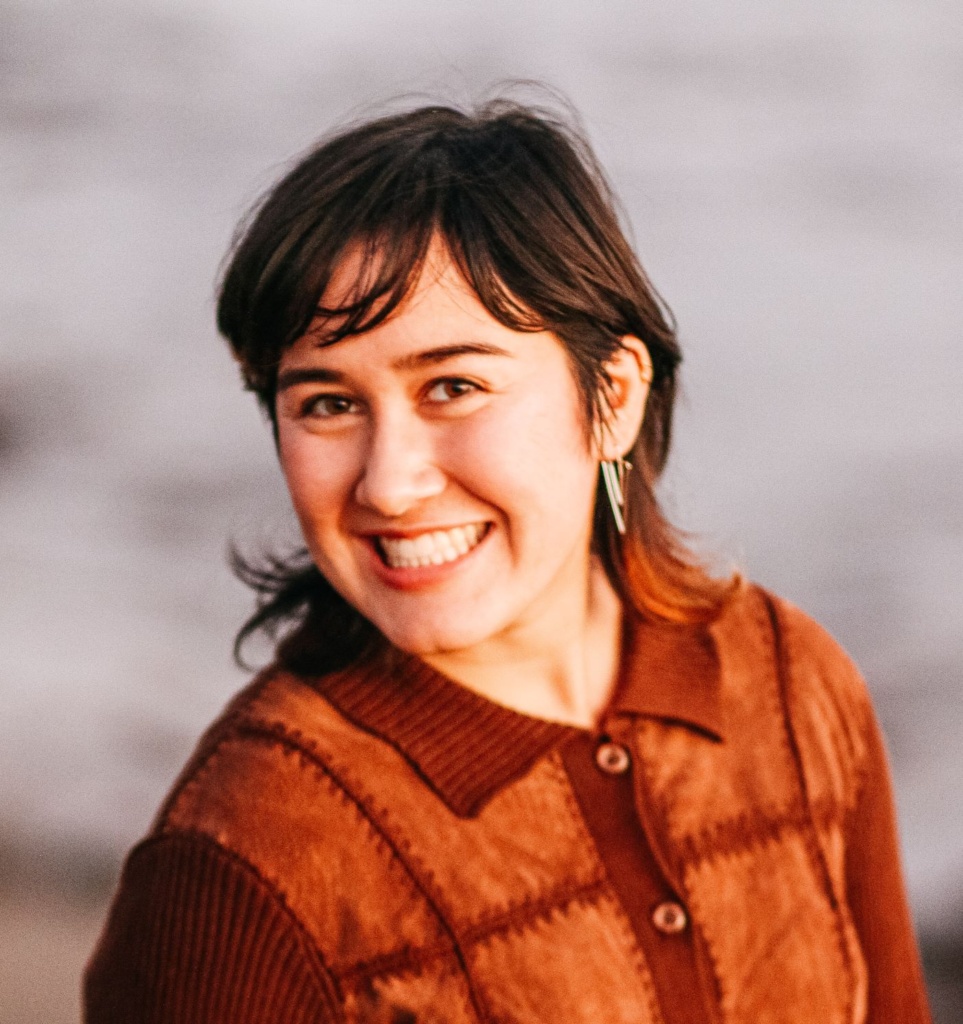
Welcome, Veronica Moran!

April 3, 2023 by Santa Barbara Channelkeeper

Channelkeeper is delighted to welcome Veronica Moran to our team as a Part-Time Administrative Assistant. In addition to her friendly, can-do approach and passion for environmental science, Veronica brings professional experience and a strong work ethic. She will be supporting Channelkeeper’s clean water work by helping with community outreach, administrative duties, and monitoring fieldwork. We took a moment recently to learn more about the experiences that inspired Veronica to join our staff.

Where did you grow up? What schools did you attend? 

I was born and raised in Santa Barbara. I went to Cleveland Elementary, Santa Barbara Junior High, Santa Barbara High School, Santa Barbara City College, and I recently graduated from Cal State University Monterey Bay. 

What sparked your interest in environmental science? 
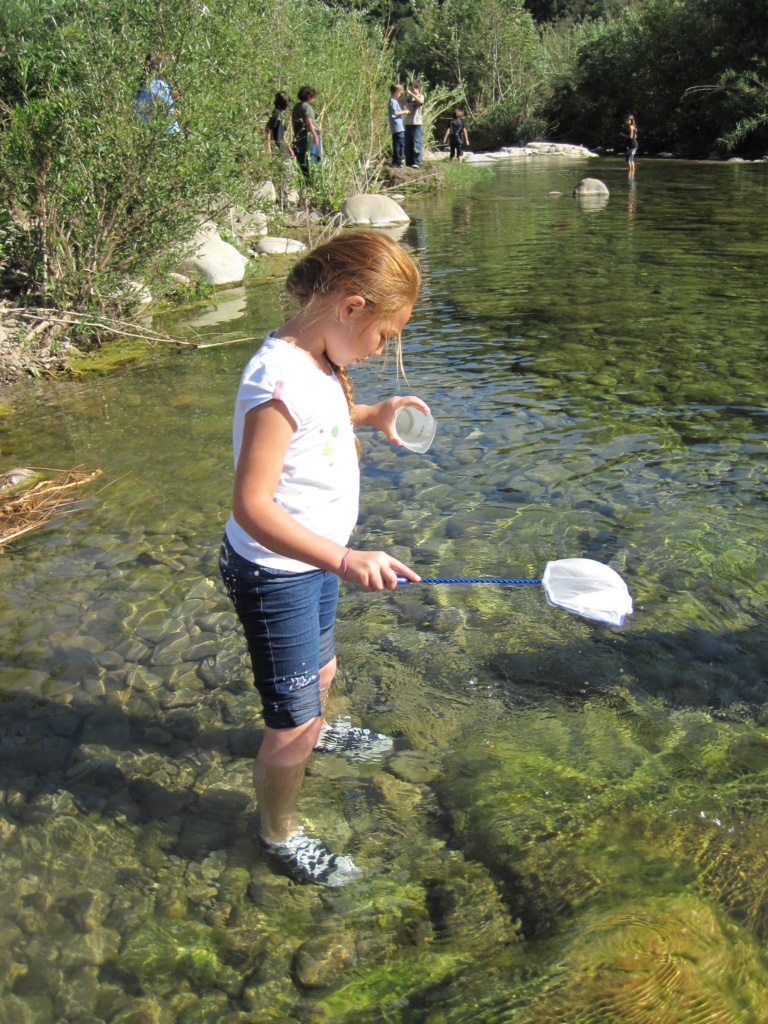
When I was in 6th grade I joined my school’s science club which was run by an amazing teacher named Mr. Criley at Cleveland Elementary. My love for science really grew while being in the Explorers Club, he made learning so much fun by engaging students with hands-on activities and guest speakers. When I was in junior high, I went back to volunteer for the Explorers Club. During this time one of the guest speakers was Penny Owens, Santa Barbara Channelkeeper’s Education and Community Outreach Director.  She took us to our local creek to teach us about water quality monitoring. She also joined us on an overnight trip we took to Santa Cruz Island. The time I spent with her sparked my interest in environmental science.  

How did that affect your career path? 
Whenever people would ask me what I wanted my career to be, I would always tell them about the work that Santa Barbara Channelkeeper does and that my goal was to work for the organization or one very similar to it. I recently graduated from Cal State University Monterey Bay with a B.S degree in Biology with a minor in Environmental Science. I’m very happy to have made my goal a reality and that I get to work with someone who has inspired me and with all the other amazing people at Channelkeeper. 

What do you like to do when you’re not working? 
I love taking my dog Sandy hiking or to the beach.  

Do you have a favorite macroinvertebrate? 
I think caddisflies are cool because when they are in the larval stage they build little houses out of rocks, twigs, and shells. 

We understand that your last job involved monitoring native and non-native plant species at Fort Ord National Monument for the Bureau of Land Management. Do you have any fun anecdotes to share related to that experience? 
Native plants are so important in order to have sustainable habitats and species biodiversity. I really enjoyed learning how to identify these plants. My favorite experience at Fort Ord was monitoring a Grassland plot which is grazed by goats. The goats eat the exotic plants which allows native plants more opportunity to grow. At the end of one of our surveys, the goats were let into the plot and our team was surrounded by hundreds of goats! 

On a scale of 1-10, how would you rate your relationship with snapping shrimp? (1 being “strongly dislike” and 10 being “love the little critters”).
My relationship with snapping shrimp is a 9, they are really cool critters! It’s so interesting how they have evolved to produce such a powerful shockwave. But I have to take a point off because one used their powerful punch on me while I was looking through a holdfast it was hiding in. 

Do you have any long-term goals for your work at Channelkeeper? 
I love Channelkeeper and the work that we do for the community, so my goal is to be able to learn and grow within the organization.  
Filed Under: Education

Honoring Local Impacts of the Clean Water Act on the 50th Anniversary

September 30, 2022 by Santa Barbara Channelkeeper

Clean water is central to our identity and way of life on the South Coast. The health of our ocean—and the creeks, rivers, wetlands, and watersheds that flow into it—directly affects our community’s health and happiness, our economy, and the ecological richness that makes this place so unique.

This month, we’re celebrating the 50th anniversary of the Clean Water Act, which has played an important role in improving the water quality of the Santa Barbara Channel and its watersheds, as well as waterways across the nation.

Before the Clean Water Act, only one-third of America’s waterways were considered clean enough to be fishable or swimmable. Many of our nation’s waters were contaminated by sewage, oil, trash, industrial pollution, and agricultural runoff.  Rivers in some areas were so polluted that they caught on fire. In response to public outcry, in October of 1972, Congress passed the Clean Water Act to address water quality issues by regulating the amount of pollutants discharged into our natural water systems and establishing national standards for water quality.

The Clean Water Act represented a milestone in our nation’s environmental history. It took significant steps to stop dumping raw sewage and untreated industrial waste into our waters. It set a goal to restore and maintain the chemical, physical, and biological integrity of the nation’s waters for the use and benefit of everyone. It also gave every person the right to enforce the law when the government fails to protect clean water. 

Since then, Channelkeeper and other Waterkeepers across the United States have used the Clean Water Act to stop pollution, to prevent habitat destruction, and to set water quality standards that ensure our waterways are healthy for both wildlife and people to use and enjoy.

In fact, the Clean Water Act forms the backbone of Channelkeeper’s work. In 1999, Santa Barbara County had the highest number of public health warnings for poor water quality of any coastal county in California. Since then, Channelkeeper has leveraged the Clean Water Act to improve water quality along the South Coast by motivating polluters like Halaco Engineering Co., the Ojai Quarry, and Southern California Edison to clean up their operations. We have also used the Clean Water Act framework to effect policy changes to better protect our community from sewage overflows, industrial pollution, and agricultural discharges.

There is still work to be done to defend our community’s right to clean water and healthy habitats, but we hope you’ll join us in honoring the 50th anniversary of a law that has improved the health and safety of the ocean, creeks, wetlands, and rivers that we love and continues to help keep our waterways, wildlife, and community vibrant.


Filed Under: Education, Uncategorized Tagged With: clean water act, water quality

Connecting Kids with Nature to Spark Wonder and Inspire Environmental Sensitivity

March 24, 2022 by Santa Barbara Channelkeeper

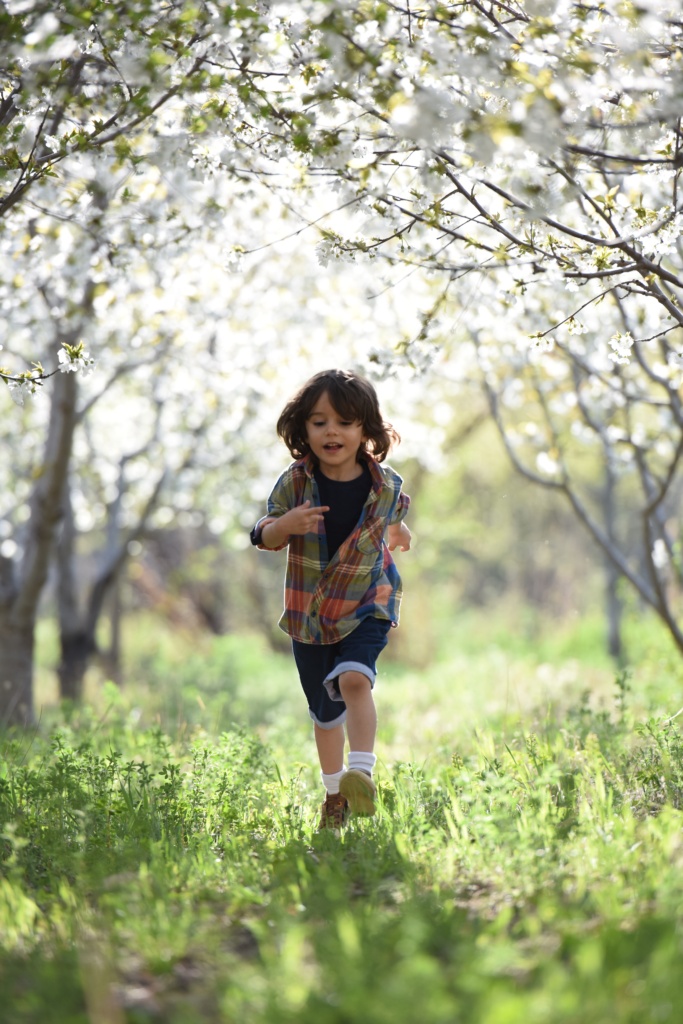
If you’ve ever followed a hermit crab’s footprints across a tidepool, built a fort in the wilderness, or listened closely to a bird’s song, you understand the sense of wonder and quiet joy that activities in the wild can inspire. For kids, the natural world can be a place of curiosity, creative play, and discovery. 

A growing number of studies suggest that connection with nature has significant physical, psychological, and academic benefits for kids. Time in the wild can also inspire greater sensitivity to the surrounding world, a deeper understanding of environmental issues, and real-life opportunities to practice problem-solving. 

Channelkeeper’s education programs aim to nurture environmental awareness and stewardship in young people with the understanding that today’s youth are the decision-makers of tomorrow. Their environmental ethics are critical to our planet’s future. By fostering a connection between young people and the natural world, we hope to inspire the next generation of clean water leaders. 

To extend our discovery-driven curriculum beyond field trips and classroom visits, we’ve gathered a few fun, hands-on educational activities for young explorers and families to experience together. Learn about how water moves through a watershed and the ways in which it can become contaminated. Discover the fluid dynamics of the water cycle. In addition, we’ve included some special places to explore with activities such as rock hopping in Mission Creek at Rocky Nook Park, tidepooling at Coal Oil Point, bird watching at the Goleta Slough, and reading inspiring stories in the shade of a tree.

We hope that you share these activities with a special child in your life and enjoy a moment in nature together.

Activities:

Make a Watershed 

Have you ever wondered where water goes when it rains? In this simple activity you can make a model watershed and watch how the water flows over the land.

  • Crumple up a piece of plain office paper and then smooth it back out most of the way- it should remain a bit crumpled, showing small ridges (high points) and valleys (low points). 
  • Imagine that this paper is a section of land. Find the ridgelines (the tops of the fold-lines). 
  • Use a washable blue marker (not permanent) to color along the ridgelines on your land. The blue color from the marker will help you follow the path of the precipitation.
  • Use a spray bottle of water to create a rainstorm over your land. The goal is to create gentle sprays of mist. 
  • Spray the bottle once, and observe the precipitation. Has the water begun to move in your watershed? If not, then lightly mist again, until the precipitation starts traveling on your watershed. 
  • As your rainfall accumulates, observe the pathways where the excess rainfall travels.

Explore your watershed. With your finger, trace your stream (the path of the blue marker) all the way back up to where it starts at the top of the ridge. When you reach the top, this is the edge of the watershed for your stream and lake. Trace the entire edge of the watershed with your finger by following the ridgeline.  Everything inside, the downward-sloping area you have just outlined is the watershed for your stream or lake.

Find the Solution to Pollution 

  • Gather up 4-5 clean glass jars, masking tape, paper coffee filters, and a magnifying glass. 
  • Collect water from different sources including tap water, a creek or lake, or even the ocean making sure to label each jar with the water source.
  • Fit the coffee filters just inside the mouths of additional large, wide-mouthed jars. 
  • Take one of the water samples, and slowly pour the water through the filter into the other jar. Repeat for each water sample, pouring it into a new jar with a fresh coffee filter. 
  • Open each filter and examine it through the magnifying glass. 
  • Analyze the filters. Which filter is the most discolored? Which filter caught the most particles? Did any of the samples leave a colored residue on the filter? 
  • Discuss how the water in creeks, rivers, and the ocean can become polluted. Where do pollutants come from? 
  • A major cause of water pollution in Santa Barbara and Ventura Counties is nonpoint source pollution, or contamination that comes from more than one source. As water runoff moves over land, it picks up and carries natural and human-made pollutants into our creeks and rivers, which eventually drain into the ocean. What steps can we take to reduce water pollution in our area?

Create a Water Cycle Model

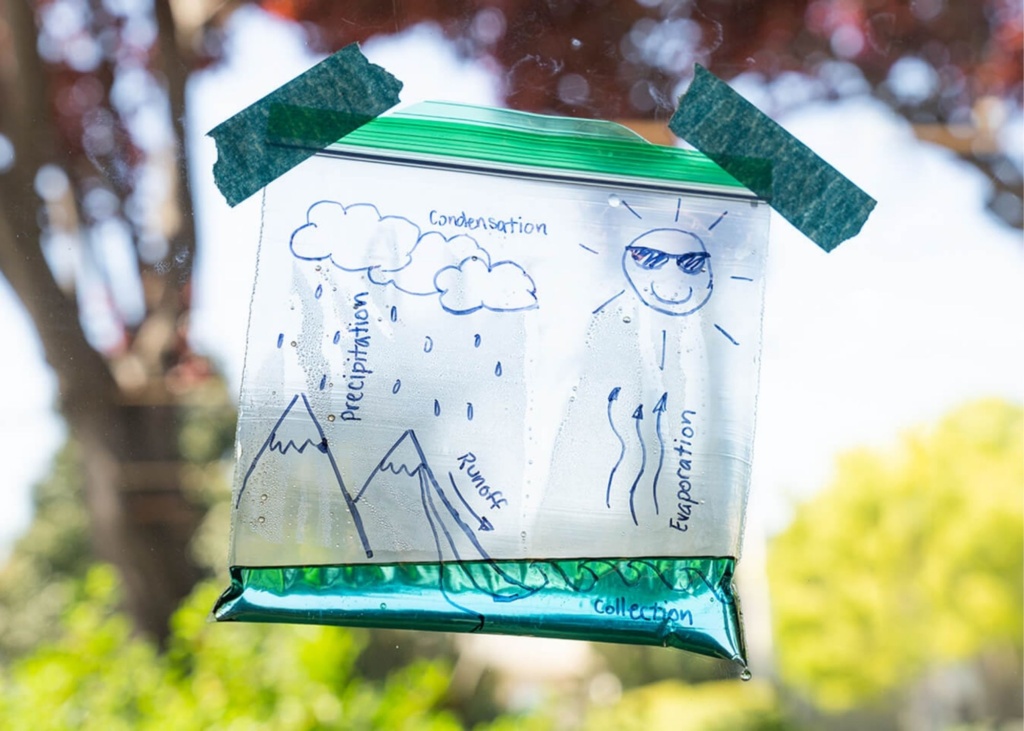
  • Use a permanent marker to draw the water cycle on a Ziplock bag (if possible, reuse a plastic bag for this activity). You can create your own interpretation of water collection, evaporation, condensation, and precipitation or follow this easy video.
  • Pour about ⅓ cup of water into the bag. You can add one or two drops of blue food coloring to the water if you choose, but it’s not essential.
  • Find a sunny window and tape the bag to the glass.
  • Check in on the water cycle bag at different times throughout the next few days. Do you see water droplets form along the bag from the condensation? Eventually, you may see streaks along the side of the bag as the droplets grow and drop down the side, representing precipitation. From there, the water will recollect and pool at the bottom, mimicking the water cycle we experience on Earth.
  • Rinse out the plastic bag and reuse it for other household needs!

Outdoor Adventures:

Visit Mission Creek in Rocky Nook Park
Rocky Nook Park is not only free to visit, its creek area is a special place to connect with nature. Practice your rock hopping skills and get to know Mission Creek’s pools while looking for tadpoles. How many different kinds of water bugs can you find? Pick up 5 pieces of trash to leave the park a little cleaner than you found it.

Low Tide Beach Walk
Check the tides and head to the beach to explore during low tide! How many creatures can you count? Can you find the wrack line, the horizontal line on the beach where kelp, driftwood, and insects collect? This accumulation area plays an important role in beach ecology. How many hermit crabs can you find in a tidepool? Can you find a sea star? Their populations are just starting to recover following a wasting disease. Be sure to leave them on the rock where you observed them! Check for low tides at Tide Predictions – NOAA Tides & Currents

Some of our favorite tidepools to explore include Tarpits Beach in Carpinteria, Leadbetter Beach in Santa Barbara, and in the Campus Point Marine Protected Area at Coal Oil Point in Isla Vista.

Watch the Birds
We’re so lucky! The Santa Barbara area has so many great opportunities to observe birds, including many species that pass through seasonally. Have you ever spotted a red tail hawk? How about a snowy egret? We challenge you to find your favorite bird! What sort of habitat does it prefer? What does it like to eat? What sounds does it make?

Visit the Goleta Slough, Lake Los Carneros, and Santa Barbara Bird Refuge for some excellent birding and check out the free ebird app for help with bird identification and cool facts!

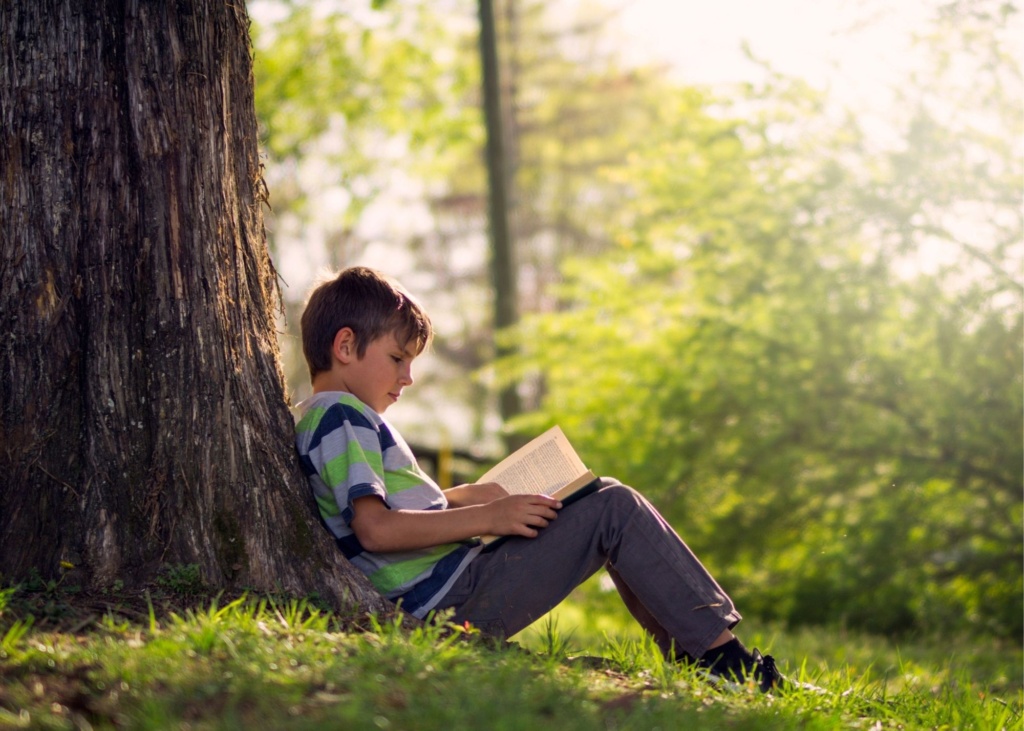
Read books outside!

Have you ever read a book with your feet in a creek? How about under a tree? Borrow a few books from your local library or find them online and head outdoors! Some of our favorites include:

  • Once Upon a Watershed by Dianne Bennett
  • The Big Book of the Blue by Yuval Zommer
  • Deep in the Ocean by Lucie Brunelliere
  • All the Way to the Ocean by Joel Harper
  • The Little Creek that Could by Marc Angelo
  • The Lorax by Dr. Seuss
  • The Watcher: Jane Goodall’s Life with the Chimps by Jeanette Winter

Filed Under: Education, Uncategorized Tagged With: Activities, Education, environment, kids, nature, Science, young people

Knowledge is Power for Meaningful Plastic Reduction

July 6, 2021 by Santa Barbara Channelkeeper

If you look around your living space, you’ll likely notice that nearly everything involves plastic, from the furniture and electronics to your favorite shirt and the packaging that keeps your salad fresh.

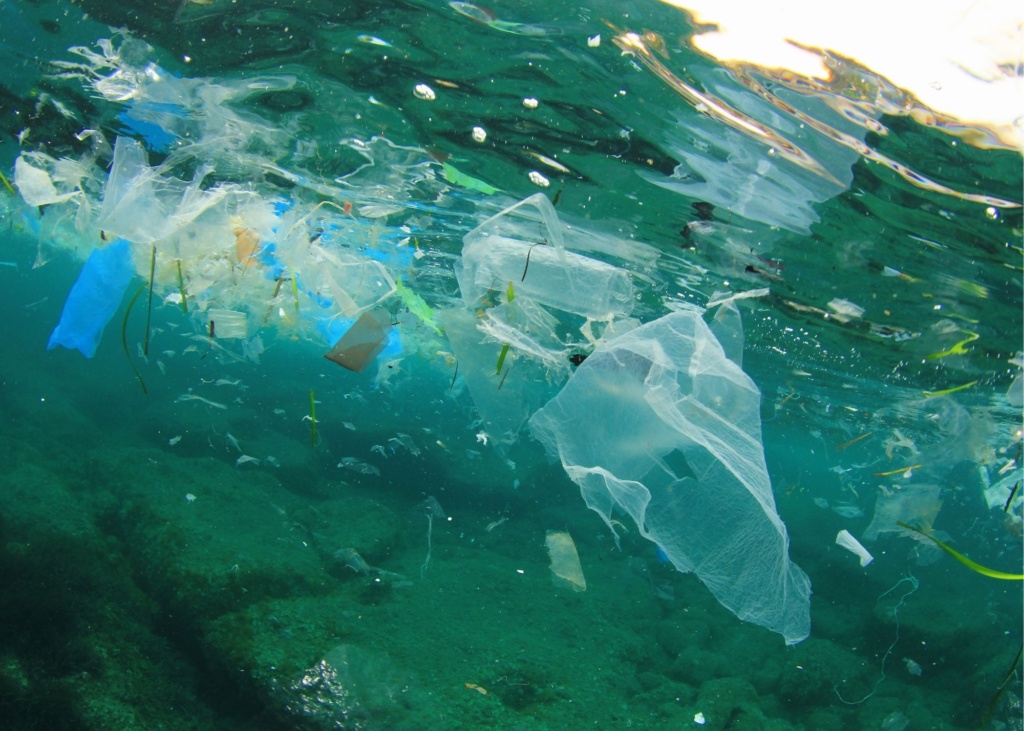
Plastic is composed of polymers—typically made from fossil fuels—that allow it to be malleable or rigid, flimsy or durable. These qualities make plastic useful for a variety of purposes but also allow it to persist in the environment. Instead of biodegrading, plastic breaks into smaller pieces that can leach chemicals and contaminate water sources.

An estimated 50% of plastic used daily is considered single-use, or disposable items that are designed for short-term functionality but will last in the environment for decades. Plastic pollution has significant impacts locally and globally, which is why reducing single-use plastic continues to be a major focus of Channelkeeper’s work. 

Reducing our reliance on single-use plastic on an individual level can have a real impact, but sometimes it’s hard to know where to begin. Doing a plastic audit is an excellent way to evaluate the amount of plastic you use and use this insight to pinpoint areas where you can reduce your reliance on plastic with zero-waste alternatives. 

How to Conduct a Plastic Audit:

  • Collect the waste you accumulate in one week.
  •  Separate trash by material, placing any plastic items in a separate pile.
  • Estimate the volume or percentage of waste in each pile and write down totals.
  • Make note of any frequently discarded plastic items and ways to avoid plastic waste. What swaps can you make?
  • Set goals to reduce your reliance on plastics. Reflect on these goals on a regular basis and track your progress.

Arianna’s Path to Plastic Reduction

In honor of Plastic Free July, Channelkeeper communications volunteer Arianna McDonald conducted her own week-long plastic audit. Along the way, she learned about her individual plastic usage and found areas where she could reduce her reliance on plastics. We’re grateful for her hard work and her willingness to share these valuable insights from her experience.

Hi, I’m Arianna, a fourth-year university student at UCSB, majoring in political science. My studies at UCSB have inspired me to take personal responsibility for taking care of the environment and practice ways of living more sustainably. In preparation for Plastic Free July (my first one!) I decided to do a plastic audit in order to figure out where most of my plastic waste comes from and to find the best strategy for reducing my overall consumption. Follow along with me to see what I found!

Sunday

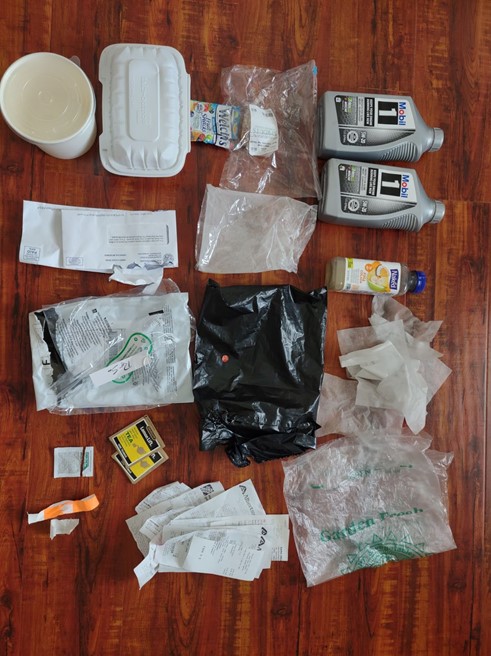
I went out for brunch with friends. After our meal, I still had half of my burrito left and chose to use the restaurant’s to-go container, even though it was made of plastic so that I didn’t waste food.

Monday

This morning I went to work out at the campus gym. We’re required to wipe down the equipment after we use it with disposable wipes, which contain plastic fibers. Afterward, I noticed that the oil in my car was low, so I bought a couple of quarts of oil from the gas station, and they came in plastic containers. I went to the library to do some schoolwork and was a bit hungry, so I decided to buy a smoothie. The bottle and label are made of plastic and can possibly be recycled. I had a pear after my dinner and found that the produce sticker was also made of plastic. Produce stickers are so frustrating because a piece of fruit should be the least harmful to the environment to eat, and yet those pesky stickers complicate things! I guess one way to avoid this would be to shop at the farmer’s market. Noted! Next week I’ll bring my own bag and my shopping will be as waste-free as it gets.

Tuesday

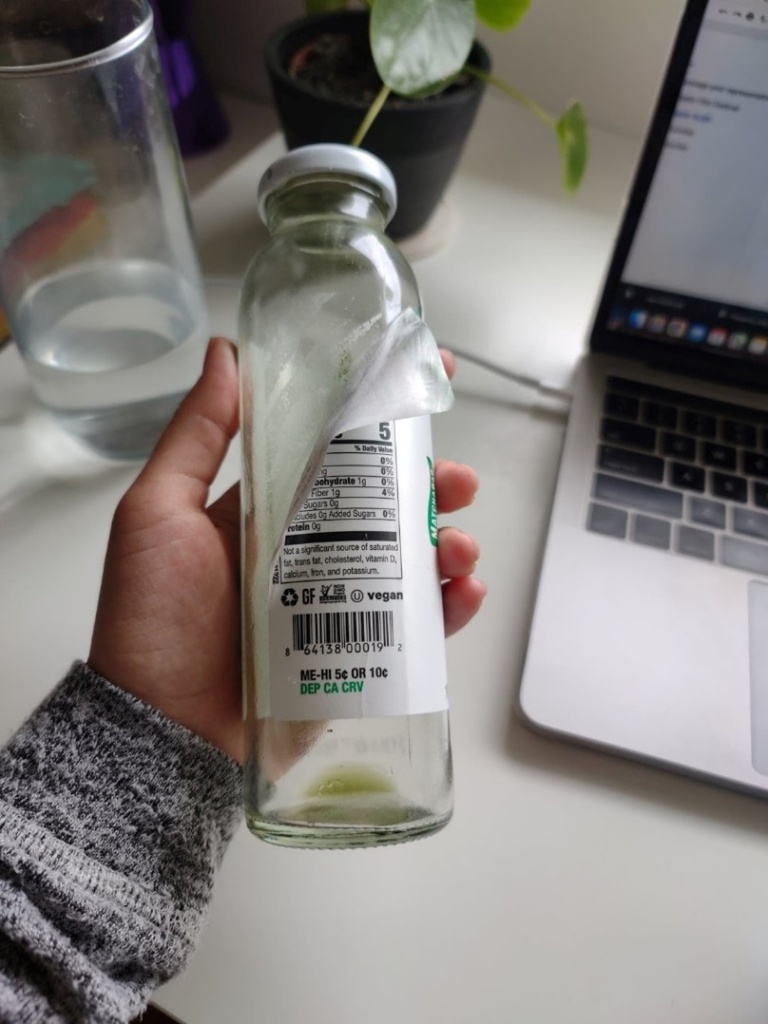
Plastic is everywhere–even the label on this glass bottle is made of plastic.

I went on campus to study and had a muffin for breakfast. The muffin came wrapped in plastic wrap inside a plastic bag. I bought a can of tea, which I recycled when I was finished, but the store receipt cannot be recycled or composted since it is coated in toxic materials called Bisphenol A or BPA. My housemates wanted to have a movie night, so we made some hot chocolate and popcorn. The hot chocolate packets and parmesan cheese packets were made out of non-recyclable plastic and plastic-covered paper.

Wednesday

This morning was gloomy, so I decided to make some muffins from a mix. The mix came sealed in a plastic bag. As a busy college student, I consume a lot of caffeine, and with a full day of work ahead, I decided to buy a tea. The drink came in a glass bottle (which I felt good about) but the label was made of plastic. I also kept the receipt because it can’t be recycled or composted.

Thursday

I sipped some tea this morning, and the bag came in a plastic sleeve. Since it was a Thursday and the last day I had class, I decided that I would go visit a brewery downtown with my boyfriend. They gave us wristbands, which are made of a plastic-y paper material. It was a colder night than usual, and we were craving soup, so afterward we went to a restaurant for some ramen. I was unable to finish mine so had to ask for a to-go container to take the rest home. Leftovers 2, me 0.

Friday

Today I finally decided to get rid of my ratty toothbrush and switch it out for a new one. I bought them in a pack so I still have another plastic one, but I decided that after this I am going to get a brush with a bamboo handle that can be composted.

I had a headache while I was at work, so I bought some aspirin from the store, which came in a little plastic sachet. Although this worked in a pinch, I get headaches pretty frequently so in the future I will remember to buy painkillers in bulk and keep them in my car to reduce my single-use plastic use.

Saturday

I went out for brunch for my friend’s birthday. This time, however, I remembered my own container! I felt a little silly whipping it out (especially after I’d finished my entire meal), but my friends were really supportive and commented on what a good idea it was to bring one along. They decided to start bringing their own containers too. Maybe I am finally starting to get the hang of this! Last week I ordered a new bathing suit for summer. It arrived today, shipped in plastic packaging. The tags also had a plastic coating, and the sizing stickers were made of plastic. I purchased the swimsuit from a Black-owned company that uses sustainable practices, which I value and felt was worth the tradeoff. I also received some mail from the city, and they used those envelopes with a little plastic window to display my address. Although these are accepted in recycling facilities, I decided to count it as plastic waste because I am uncertain as to whether or not these items are actually being recycled.

Key Takeaways

As I finish out the week, I am beginning to notice a few themes in my plastic consumption. My busy schedule and hectic days often lead me to be unprepared, and therefore I find myself turning to plastic products for convenience. I found that most of my plastic consumption comes from food and drink packaging since I am on the go and eat out pretty frequently. If I can remember to keep a reusable to-go container with me in my bag, and maybe pack some of my snacks/meals at home to take with me, I could use less plastic and packaging.

Overall, the plastic audit was really helpful. The insights that I gathered by evaluating my usage will help guide my plastic reduction strategy in the coming months. I look forward to making choices that will benefit the environment and might even save me money in the long run.   

Filed Under: Education, Uncategorized Tagged With: microplastic, plastic, Plastic Audit, pollution, recycle, zero-waste

Santa Barbara Channelkeeper’s Plastic Film Festival

May 20, 2021 by Santa Barbara Channelkeeper

Watch, Learn & Take Action

Plastic pollution is a mounting global concern, and it has significant impacts locally, which is why reducing single-use plastic continues to be a major focus of Channelkeeper’s work.  In an effort to help educate and inspire our community, we’ve compiled a list of seven informative films about plastic that are available to stream online. It’s the perfect opportunity to host a documentary film festival in the comfort of your home.

People often think of plastic pollution as litter. However, plastic pollution is more than the clutter of single-use items that wash down storm drains and collect on our beaches. Plastic has severe consequences throughout its lifecycle. From oil drilling and refining to plastic production and waste, every stage is detrimental to human health, and these harmful processes have created a social justice crisis, since the most vulnerable communities are often disproportionately affected.   

Plastics are poisoning our bodies through the air we breathe, the water we drink, and the food we eat. Recent studies show that on average, each of us consumes a credit-card-sized amount of microplastics every week, which can carry toxic chemicals such as carcinogens and endocrine disrupters.  

Plastic is also a contributor to climate change. More than 99% of plastic is made from fossil fuels. Today, about 4-8% of annual global oil consumption is associated with plastics, according to the World Economic Forum. Plastic production is expected to more than double over the next three decades. If this reliance on plastics persists, plastics will account for 20% of oil consumption by 2050.  

Channelkeeper continues to work locally to educate the community about the impacts of single-use plastic and ways to reduce its use, while also continuing to advocate for local policies to reduce single-use plastic and helping to set an example for the state. With studies predicting that plastic pollution in the ocean will likely triple over the next decade, we recognize the urgency of taking immediate action to address this crisis. 

We invite you to watch these films, discuss them–and then join us in taking action.

A Plastic Ocean  (1hr 42m)
Available on: Netflix or Amazon
This 2016 documentary follows a team of scientists and researchers as well as record-breaking freediver and activist Tanya Streeter, as they travel to 20 different locations across the globe. Directed by journalist Craig Leeson, the film juxtaposes beautiful shots of the ocean with contrasting views of polluted cities and landfills teeming with rubbish. The film reveals how plastic in the ocean gets mistaken for food by marine animals, and goes on to harm organisms all the way up the food chain, including humans. 

Frontline’s Plastic Wars (54m)
Stream on PBS
FRONTLINE and NPR team up to investigate the surge of plastic waste in the environment. Plastic Wars reveals how plastic makers have publicly promoted recycling for decades, despite privately expressing doubts that widespread plastic recycling would ever be economically viable.

Inside the Garbage of the World (54m)
Available on: Amazon Prime
This film explores the plastic island in the Pacific and reveals that the situation is actually more dire than anyone anticipated. Directors Philippe and Maxine Carillo evoke a sense of urgency in changing our behavior in order to preserve our planet and our way of life. 

Microplastic Madness  (1hr 16m)
Vimeo Trailer / Available on YouTube
Told from a child’s perspective, this film follows 56 fifth graders from Brooklyn as they investigate plastic pollution in their community. They collect data which they use to inform policy and set out to rid their cafeteria of all plastic.

Plastic China (1 hr, 22 m)
Available on: Amazon Prime
This film relates the story of people in China who live surrounded by plastic. Tons and tons of plastic are exported to China to be recycled and manufactured into something new. Yi-Jie is an 11-year-old girl whose family lives in one of these waste workshops. Plastic China shows the price that living and working under these circumstances has on their health and way of life.

Plastic Paradise (57m)
Available for rent on Amazon
This film takes us to Midway Atoll, an unincorporated territory of the US off Hawaii, and the site of the Battle of Midway during WWII. In the middle of the Pacific Ocean with no civilization nearby, the atoll has become a collection site for the waste of the world. Brought in by the currents and tides, the atoll is littered with a massive amount of plastic and garbage that is degrading the paradise which surrounds it, which has become the case all over the Pacific, leading it to be dubbed the Great Pacific Garbage Patch. Journalist Angela Sun narrates, writes, and directs the film, interviewing a variety of ocean experts, scientists, and advocates.

The Story of Plastic (1hr 35m)
Available on: DiscoveryGo or for rent on Amazon 
With powerful insight, this eye-opening film provides a comprehensive look at the global plastic pollution crisis and the ways in which the oil and gas industry has manipulated the narrative around it. The film highlights the fact that, as consumers, our everyday choices add up. 

Filed Under: Education, Marine Conservation, Outreach Tagged With: marine debris, microplastic, plastic

  • « Go to Previous Page
  • Page 1
  • Page 2
  • Page 3
  • Go to Next Page »

Contact Us

714 Bond Avenue
Santa Barbara, CA 93103
info@sbck.org
(805) 563-3377

Subscribe to eNews

© 2026 Santa Barbara Channelkeeper | Website by Mission Web Marketing
NAVIGATION
  • About
    • Our Mission & Vision
    • Our Team
    • Our Boat
    • Our History
    • Our Impact
    • About the Santa Barbara Channel
    • About Local Watersheds
    • Strategic Framework
    • Financial Information
    • Careers
    • Contact Us
  • Our Work
    • Education
      • Student Art Show
    • Community Engagement
      • Cruise Ship Advocacy
      • Report Pollution
      • Volunteer
      • Water Conservation
      • Oil Spill Resource Guide
      • Film Plastic Recyling
      • Action Alerts
    • Field Work
      • Beach Water Quality
      • Stream Team
        • Water Quality Indicators
        • Stream Team Data Portal
        • Leydecker Archives
      • MPA Watch
      • Cruise Ship Monitoring
      • Ocean Acidification
    • Advocacy
      • Aquaculture Advocacy
      • Polluted Runoff
      • Agriculture
      • Oil & Gas
        • Protecting the Coast from Sable Offshore’s Pipeline Restart
        • Refugio Oil Spill
        • Oil Spill Resource Guide
        • Platform Decommissioning
        • Legacy Oil Wells
        • Offshore Fracking
      • Ventura River
      • Plastic
        • Film Plastic Recyling
      • Marine Protected Areas
        • MPA Watch
      • Water Supply
        • Desalination
        • Conservation
    • Enforcement
      • Ventura River
      • Offshore Fracking
      • Agriculture
      • Sewage
      • Ojai Quarry
      • Halaco
  • Media
    • Press Releases
    • Blog
    • Newsletter Archive
    • eNews Archive
    • Photo Gallery
    • Video Gallery
  • Take Action
    • Donate
    • Events
    • Volunteer
      • Watershed Brigade
      • MPA Watch
    • Report Pollution
    • Action Alerts
    • Subscribe to eNews
    • Shop
      • Buy Channelkeeper Gear
      • Shop & Support Channelkeeper
  • Donate